
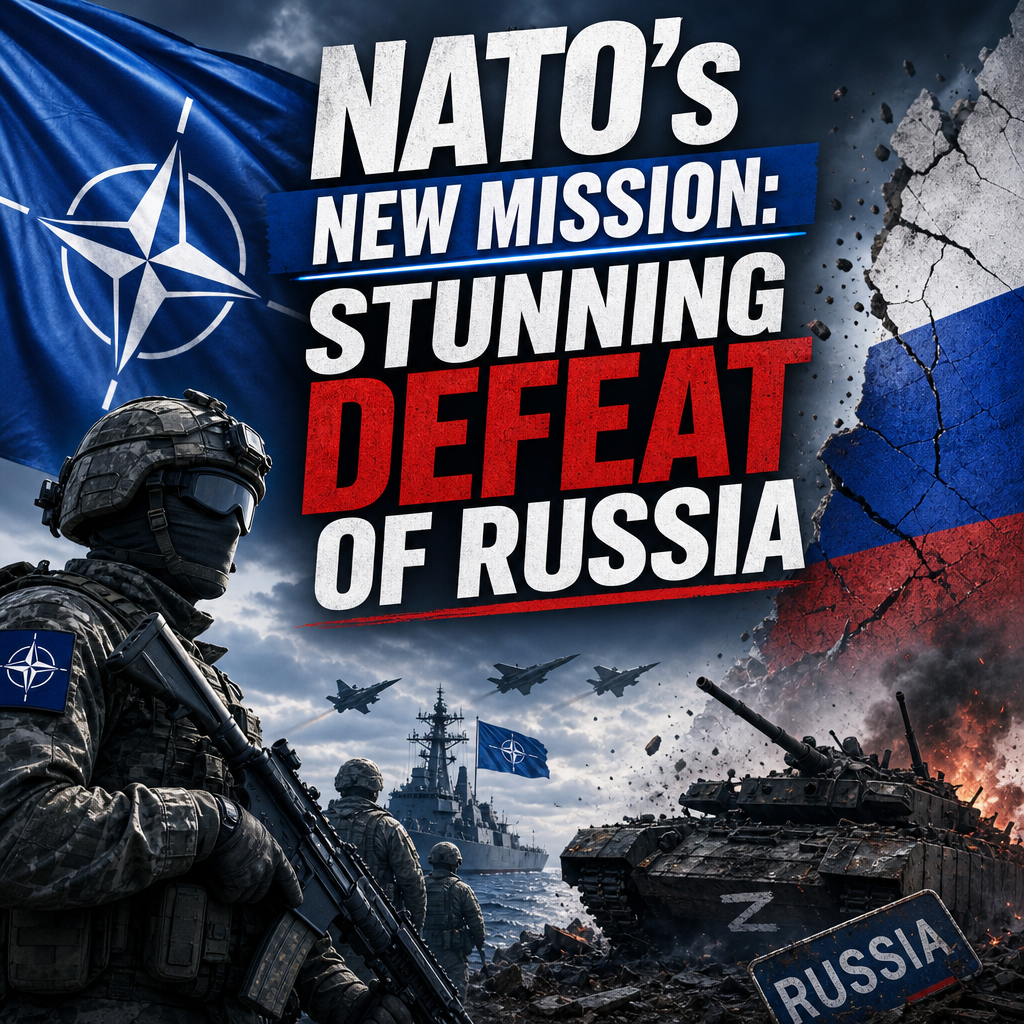
NATO’s New Mission: Stunning Defeat of Russia


NATO’s New Mission is no longer being framed only as collective defense; increasingly, it is being discussed as a test of whether the alliance can deter Russia without sliding into open-ended militarization.
The conversation around the alliance has sharpened because the war in Ukraine has changed NATO’s purpose in practice, even if its founding logic remains the same on paper. Supporters argue that a tougher posture is unavoidable after Russia’s invasion and repeated pressure along Europe’s eastern flank. Critics, meanwhile, warn that the alliance’s newest direction looks less like deterrence and more like a permanent war footing. Taken together, the debate suggests that NATO is trying to do two things at once: reassure its members and signal strength to Moscow, while avoiding a direct clash that would be far more dangerous.



NATO’s New Mission: deterrence, defense, and political signaling
For many in Western governments and aligned media, NATO’s expanded role is a response to a changed security landscape. The alliance has increased troop deployments, strengthened air defense, expanded exercises, and pushed members to spend more on their militaries. In that view, these steps are not provocative for their own sake; they are insurance against a Russia that has shown willingness to use force, hybrid tactics, and coercive diplomacy.
That argument tends to emphasize a few points:




– Russia’s invasion of Ukraine shattered assumptions about post-Cold War stability.
– Eastern European members want visible reassurance, not abstract promises.
– Military readiness is meant to prevent escalation, not invite it.
From this perspective, the alliance’s “new mission” is really an old mission sharpened by new realities. The goal is to make any attack on NATO territory unthinkable. In practical terms, that requires better coordination, faster reinforcement, and more credible defense planning than many European states maintained before 2022.
Still, even proponents of a stronger NATO acknowledge a tension: the more the alliance resembles a front-line military bloc, the easier it becomes for Russia to portray NATO as the aggressor. That message matters, especially in countries where audiences are skeptical of Western foreign policy or wary of deeper confrontation.
The criticism: militarism or necessary deterrence?
This is where the divide becomes most visible. Russian state-aligned coverage has consistently portrayed NATO’s expansion and military buildup as evidence of hostility, not prudence. The core claim is that the alliance is using Russia as a justification for greater militarization, widening its footprint in Europe while presenting itself as purely defensive. In that reading, NATO is not responding to danger so much as helping create it.
That criticism resonates beyond Russian media, even if many analysts reject the broader conclusions. Some observers in the Middle East, parts of the Global South, and even within Europe ask whether the alliance’s language leaves enough room for diplomacy. If NATO leaders frame Russia mainly as a long-term threat, then they may weaken incentives for negotiation and make compromise politically harder.
But the critique also has limits. It is difficult to argue that NATO simply invented the security crisis. Russia’s actions in Ukraine, Georgia, and elsewhere have made threat perceptions more acute, especially among states that sit closest to Russian territory. For them, the alliance’s military posture is less an ideological project than a survival mechanism.
The real issue is not whether NATO should defend its members, but how far that defense can expand before it begins to look like escalation in practice.
What the reporting suggests across the spectrum
Looking across the different media lenses, a few patterns stand out.
1. Western coverage often focuses on deterrence and solidarity
Mainstream Western reporting, including outlets such as Sky News, generally treats NATO’s moves as a response to urgent security demands. The emphasis is on troop readiness, member unity, and the political message sent to Moscow. The language tends to suggest that restraint without strength would be dangerous.
2. Al Jazeera often highlights the broader geopolitical cost
Al Jazeera’s coverage of international security issues typically gives more attention to the diplomatic and humanitarian consequences of military escalation. That does not mean it endorses Russian arguments, but it often asks harder questions about how long confrontation can last, what it means for civilians, and whether Europe is locking itself into a more militarized future.
3. RT frames NATO as the destabilizing actor
RT’s coverage is predictably the most critical, presenting NATO’s expansion as proof of Western hostility and strategic overreach. Its view is that the alliance is not containing Russia but surrounding it, while using defense language to mask aggression. Even if readers discount RT’s conclusions, its framing is useful as a reminder of how sharply the conflict is understood in Moscow.
The important point is that these viewpoints do not fully cancel each other out. NATO is both a defensive alliance and a political actor. Its military decisions are meant to protect, but they also send signals. That dual role is what makes the current moment so unstable.
The bigger question: can NATO deter Russia without deepening the cycle?
The hardest truth is that deterrence works best when it is credible and limited. If NATO builds up enough force to prevent an attack, it may succeed. But if the buildup becomes open-ended, it can feed the very insecurity it seeks to manage.
That creates three open questions:
– Can NATO maintain unity if the conflict in Ukraine drags on?
– Will member states keep increasing defense spending without domestic backlash?
– Is there still room for diplomacy, or has the political climate become too hardened?
At the moment, there is no clean answer. What is clear is that NATO’s mission has already evolved beyond simple defense of a static border. It is now about managing a prolonged confrontation with Russia while keeping the alliance intact and avoiding direct war. That is a far more difficult task than the slogans suggest.
So the claim of a “stunning defeat” of Russia may be more wishful than realistic. NATO can constrain Russia, raise the cost of aggression, and strengthen its own position. But defeating Russia outright is not the same as deterring it, and confusing the two could lead to dangerous overconfidence.
The alliance’s real test is not whether it can score a symbolic victory in headlines. It is whether it can defend its members, preserve political unity, and avoid turning a regional war into a wider catastrophe.

























